Monday, January 9, 2012

Reflections on a year of motherhood

I've been thinking about this post for some time. Tomorrow my little boy will cross the threshold of months to years. Suddenly he's thrown into classifications of toddlers rather than babies and suddenly I feel as if a whole new set of joys and challenges are about to unfold.

A couple things happened tonight that made me stop and think about this past year of  mothering. For starters, Brennan was sitting on the couch telling Hyrum the story about his birth, a story that often fills me with feelings of anticipation, emptiness, and failure. Then I came across a friend's blog post about a certain book that was a part of a lot of turmoil in my early days of motherhood and a new flood of emotions emerged--guilt and frustration being the main themes.

So frequently these are the things that I think of when I think of my failings as a mother. The moments I try to sweep under the rug and pretend like they're not really there. But like the dust under the rug, it's there, and sooner or later I've got to deal with it.

Maybe this is the exact moment to do so.

I'm not a failure, even though the little voice inside of my head seems to whisper it at least once a day. The moment where I realize that I fed Hyrum toast and an orange--but no vegetables (gasp!)--for lunch. The moment where, because I'm feeling ill, I let him watch Curious George on the television in hopes of getting a few moments to rest on the couch. The moment where I question if in my resolve to never let him cry to sleep, I've destroyed his sleep habits for life. The moment where I wonder if those five minutes of crying have removed his trust in me. The moment where I can't seem to figure out if I'm giving him too little or too much attention, too little or too much love, too little or too much _______.

That blasted voice. I don't like it. And it's not me.

I'm a mother. I love my child. I want everything in the world for him and darn it, I've done a great job, no matter what the voice in my head thinks.

And so I started thinking about all of those absolutely wonderful moments. Those moments that nothing bad can touch. Those moments that live on in your memory as the pat on the back, the sigh of relief, and the reminders that not only am I doing this thing called motherhood, but I'm actually doing a pretty good job at it.

In my personal journey, here are a few of those moments.
  • The first time I held this precious child and knew that he was mine.
  • The first time I admitted to missing the feeling of being pregnant, to have that life--Hyrum's life--inside of me in such a physical and emotional way.
  • The day(s) I finished my recital/oral exam/comprehensive exam/paper/etc., not in spite of having a newborn, but because I wanted to set an example for him of finishing what I started. The first of many experiences in which I realized that my life was more than my own, it was a legacy for my children.
  • The first night I brought Hyrum to bed with me. That night and for and many nights afterwards, I fell in love with the feeling of a of a sleeping child resting in the crook of my arm, at my breast, near my heart, and by my side--a feeling of closeness, both physically and emotionally, that I will never regret.
  • The moment I was grateful for an easy going child when, because Brennan was out of town, I had Hyrum alone for four hours of church meetings. He spent hour after hour contentedly in the baby carrier through Primary program practices, ward choir rehearsals, and much more.
  • The few weeks when he refused to poop in his diaper and because I knew him so well, knew when to put him on the potty. That phase passed, but for that time, it was a surprisingly beautiful reminder that I knew him and through our communication with one another, I could give him what he needed.
  • The moment, just today, when he climbed into my lap, asked to nurse, and sat there contentedly for nearly 20 minutes, glad to be held by and cuddling with mommy
  • The moment when I picked him up from the sitter and despite my separation anxiety, realized that he had a blast because he knew I would return to him.
  • The moment every day when I kneel down to pray and  thank Heavenly Father over and over again for the blessing of this child and for this experience.
I'm sure that voice of guilt and doubt will return, and probably frequently.

But I'm grateful for those moments that tell you it's all worth it. I'm grateful for love, support and encouraging words that help tie me over in the moments when I can't remember THE moments. Most of all, I'm grateful to be a mother.


Tuesday, December 13, 2011

Weighing in on the CIO debate

There is probably no topic that separates parents and contributes to mommy wars like sleep training. I've been pretty outspoken about my dislike of the cry it out approach in the past and really, I'm still not a fan.

That being said, I've had a bit of a change of heart these past few months--partly because I'm living in a less-than-ideal baby sleeping situation currently and partly because I realize that families are doing their very best and could use as much encouragement as possible. Also, I'm starting to realize that "cry it out" really does seem to be a "damned if you do and damned if you don't" sort of dilemma. As we've been facing our own sleep dilemmas, I've been doing a lot of reading and a lot of thinking. Thus far, here are the arguments for and against CIO that seem legitimate (in my mind).

For:
  • CIO enables the baby or young child to learn the important skill of going to sleep unaided. Lack of this skill may result in years of parental involvement in aiding a child to go to sleep and/or issues with insomnia later in life.
  • CIO often results in more sleep overall and more consolidated sleep as the child is able to return to sleep unaided. Lack of sleep and consolidated sleep has been linked to lower IQ scores, less empathy, behavioral problems, and ADHD.
  • Parents are able to get the sleep they need to be understanding, empathetic, patient, and have fun with their children.
Against
  • CIO may weaken parent/child attachment, teach child that they cannot trust their parents and/or environment. This may result in less attachment promoting behaviors including less empathy and behavioral problems.
  • CIO has been linked with brain damage, lower IQ scores, and ADHD.
  • CIO may cause unhealthy fears of sleep and/or the dark.
  • CIO may cause a parent to lose trust in their baby's cues and therefore be less understanding, empathetic, patient, etc.
Anyone else see a major dilemma here? Basically, if you CIO you're destroying your child's life and if you don't CIO you're destroying your child's life...and most of the evidence points to the exact same emotional/behavioral/societal problems. Blast.

Here's what I think deep down inside. I don't think there is any one right answer.  There really is no way to quantitatively or qualitatively measure the affects of CIO, or lack thereof. However, there are a few well-established theories that most scientists and doctors agree on:

  • Babies under 12 weeks of age cannot self-soothe (Weissbluth). Therefore, it would make sense that there could be some negative emotional/psychological/sociological affects of allowing a newborn to CIO.
  • It is impossible to spoil a child in the first year of life (Erickson). (note: I'm not suggesting that parents should NOT sleep train in the first year of life. Just that there cannot be any "spoiling" if parents choose not to do so during the first 12 months).
  • Accumulative sleep deprivation can be physically and mentally detrimental to both children and their parents.
Beyond these points, I feel that most points used to sell or protest the CIO approach to sleep training are purely conjecture. Whatever side of the fence you fall on probably has more to do with your personal preferences, beliefs, and intuition.

On that last point--intuition--I just want to make mention that because of my personal spiritual beliefs and faith, I feel that parents, and only the parents, can receive personal revelation for their child. Maybe this is a bit personal, but I feel that the choice to, not to, how, when, where to sleep train, is something that should be made a matter of intense thought and prayer. It's important for parents to know and study their options, make a decision that feels right based on their family's individual circumstances at that time, and then take the matter to the Lord. Only then parents will have confirmation from the only True Source as to the best course of action for their family. I feel that if this were the way that all parents went about making decisions for their families, then maybe all of the mommy wars on this subject could stop. 

Friday, December 9, 2011

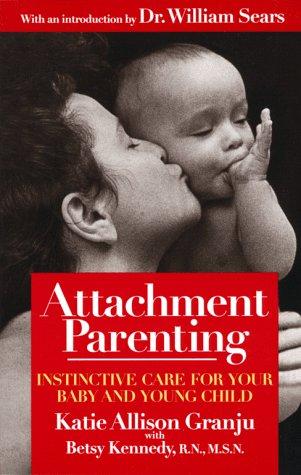
Book Review Attachment Parenting: Instinctive Care for Your Baby and Young Child

I'm on a quest to finish all of these book reviews, so please bear with me. This book was one that I read a while ago, about six months ago. Katie Allison Granju has done a marvelous job of compiling research for her book about attachment parenting. This was another "appeal to the nerd" book because, again, tons of quotes from doctors, parents, anthropologists, child development specialists, psychologists, etc.

This is definitely a book I would recommend to those who already are considering an "attachment parenting" lifestyle for them and their families rather than those who are being introduced to it for the first time (I'd recommend Dr. Sears's The Baby Book in those cases), mostly because of the passionate way she talks about attachment parenting (i.e. calling a crib a "baby cage" and carrying babies around in "baby buckets" such as car seats, swings, etc.). It would probably be a little much for an attachment parenting investigator. However, she does cover some parenting decision that aren't covered very thoroughly in The Baby Book including choices about circumcision, cloth diapering, how to choose a childcare provider or pediatrician, and extended breastfeeding.  They're touched on in The Baby Book, but Granju goes into quite a bit of detail about these decisions.

If I was to have every mother read one chapter of this book, it would be the section on breastfeeding. She dispels myths about milk production (i.e. breasts need to "build up" milk so that baby has enough to eat, schedule feeding vs. cue feeding, and pumping as a way to increase milk production) and unloads a plethora of research about the benefits of breastfeeding. However, she also acknowledges that in a small percentage of cases, some women are physically unable to breastfeed, usually due to a medical problem (loss of too much blood during child birth, a hormonal imbalance, extreme stress, etc) and in these cases gives suggestion on how to "nurse" your bottle fed baby. I really liked how she addressed that breastfeeding is much more than the milk, it's a relationship, and that no matter what, a parent can have that relationship with their child.

A second "recommended chapter" would be the chapter on baby carriers. Again, there are a lot more types now than there were when this book was published, but she goes into the pros and cons of the basic carrier types (sling, front carrier, back carrier) and how to choose a baby carrier that is best suited for your needs.

Though she is quite zealous, she is very thorough and well thought-out. For example, I was on the fence about circumcising future sons, but Granju's section on circumcision (how it's unnecessary, the benefits of an intact penis, pain experienced during and after circumcision, etc.) certainly influenced me. Also, she includes literally hundreds of resources for parents including support groups, carrier types and manufacturers, breastfeeding help, and further reading. Since her book was published in 1999, I would love it if she revised and updated this book to include a "best of" list of resources since, obviously, the advent of the internet has significantly increased a parent's resources.

So, if you're curious about attachment parenting, opt for The Baby Book or Dr. Sears's The Attachment Parenting Book (it's more or less the "getting attached" section of The Baby Book with some added information). If you're pretty sure attachment parenting is the route for you and you want some added information about the benefits thereof, check out Attachment Parenting: Instinctive Care for Your Baby and Young Child by Katie Allison Granju.

Wednesday, December 7, 2011

Spoiled is what happens to milk

It always makes me sad to hear someone say that I'm spoiling my child by holding him too much, by rocking him at night, by letting him sleep beside me, or by staying home with him. It makes me sad because spoiled is such a rotten word. It means that you have failed, it means that the product is of no use, that it's bad, that it's a waste.  Like that spoiled milk in the refrigerator--it's disgusting and unappealing.

But I don't believe it.  You see, spoiled is what happens to something that has been left alone too long. Something that did not serve its purpose. Something that has been forgotten. Something you didn't care about enough to focus your attention on it.  Something that will never be what it could have become.

And the same is with "spoiled" children.  When we began our journey as parents, I wondered if our high-touch style of parenting would spoil him. And then I thought, "what do I think of when I think of a spoiled child?"  I think of children who have everything they want-- every toy they asked for, never have to help around the home, and can do whatever they please without considering the consequences of those choices.  But I don't think those things are love.  I've never known a child to be spoiled with hugs, kisses, closeness, contact, holding, or cuddles.  In fact, when it comes to what we think of as "spoiling," it's in large part things.  Things that have been used in place of love, time, and attention.

And so, if love be spoils, then I give them. But surely my child will not be forgotten. He will not be tossed aside.  He will not be made useless.  I'm on a personal mission as part of my "have a plan," to spend more time loving, comforting, cuddling, holding, kissing, and being with my child. Maybe, one step at a time, I can help him see that things are not the answer--love and people are.


Thursday, December 1, 2011

Book Review Three in a Bed: The Benefits of Sleeping with Your Baby


I read this book a few months ago and didn't get around to reviewing it because of my silly space bar dilemma. So, here goes.

I really enjoyed reading Three in a Bed. It definitely appealed to the nerd within me as it had literally hundreds of quotes from cultural anthropologists, psychologists, medical doctors, professors, historical treatises on parenting, and the #1 experts--real parents.  There was a quote on almost every single page pointing to the benefits of sleeping with your baby, babywearing, forgoing cry-it-out sleep training, breastfeeding, etc.  It is written by Deborah Jackson, British mother of three, all of whom co-slept with her and her husband.

Jackson held traditional views about where a baby should sleep--in his crib, in his own room--until reading The Continuum Concept: In Search of Happiness Lost by Jean Liedorff.  In a section of Liedorff's book, she speaks of her experience one night sleeping in the jungle among the natives of South America.  At one point, all of the sleepers were awakened, one told a joke, they all laughed, and then went immediately back to sleep.  There were no sleep troubles and every person was able to be roused, awakened, and fall back asleep without any problems whatsoever.  In her study of this same group of natives, she found that within their culture, families slept together rather than separately, as is the custom in most of Western society.  She concluded that a lot of our sleep problems in the West--from insomnia to general tiredness--have been created by our "laboratory style" sleep conditions including lights out, comfortable bed, quietness, and undisturbed sleep. As such, these laboratory sleep conditions may, in fact, be creating sleep problems rather than preventing them.  And so, Jackson decided in the final weeks of pregnancy with her first child, to get rid of their assembled crib and bring Baby to bed with her and her husband.

Throughout the book, Jackson addresses a myriad of issues that face the co-sleeping family including the typical concerns about SIDS, overlaying, and general safety.  She also addresses practical matters such as sexual intimacy between husband and wife (which, was one part of the book that I didn't really catch her fire.  She basically subscribes to the thought that it's not that big of a deal if Baby is there, awake or asleep, and that it may even be healthy for babies and very young children to be privy to sexual exchanges between parents.  Not really my cup of tea, personally but whatever floats your boat); how to wean from the family bed when desired; as well as the emotional, health, sociological, and psychological benefits to co-sleeping.

My personal favorite section was her chapter entitled "Nomads and Nannies" where she examines parenting practices across many cultures.  She dispels the belief that all "uncivilized" and non-Western cultures are high-touch, co-sleeping, and nurturing.  Instead, she gives example after example of gentle parenting practices in some cultures, and how they, in turn, produce a culture characterized as gentle, meek, and kind.  In contrast, she gives mention to aggressive cultures that are highly disciplined, leave young babies to cry excessively (at one point, she talks about a culture that swaddles their babies and put them in a hanging basket on the wall except for when they are permitted to eat or to be changed), and who do not nurture and hold their babies.  Jackson suggests that perhaps our aggressive Western culture spawns from low-touch, overly disciplined parenting practices.  I think that's a little simplistic, but definitely some food for thought.

I would certainly recommend this book to anyone who has considered co-sleeping in their family.  I do wish she had included a little more information about how to handle a few of the issues we're currently facing in our co-sleeping situation--i.e. Mr. Baby Bed Hog and how to prevent my arms from falling asleep when they're trying to avoid Mr. Baby Bed Hog.  Again, I didn't agree or buy everything she had to say but overall, I found it to be very informative, enlightening, and thought-provoking book.

Happy Reading!

Wednesday, November 30, 2011

The Happiest Mom Challenge: Have a Plan

How did your month of "taking the easy way out" go?  I know for me I actually found it pretty liberating.  Here are some of the ways that I took the easy way out this month:

  • I scaled back my advent calendar. I had all of these high hopes of sewing an advent calendar with little pockets to hold strips of paper for an activity to do every day.  And then I decided that was too much work and decided to just make little envelopes out of wrapping paper and wrote on the inside of them.  SO much easier.
  • I decided to only tackle a chore or two a day.  Every time I have these high hopes of cleaning the entire house at once, I just end up disappointed.  As long as the laundry, dishes, and perhaps another task for the day are accomplished, then I think I'm doing pretty well!
  • I finally started planning leftovers into our meal schedule. For the past few months, I've been making our meal calendar with a new meal (and usually a brand new recipe) every day.  And then it started to become a burden to get the leftovers gone. So, I just started making a little bit extra food for our meal and actually plan on having it be supper again the next day.  The variety has gone downhill a bit but our fridge (and my sanity) is thanking me.
  • I gave up and made flip charts with all of the words for the songs in our Primary program. I had been working like crazy to help the children memorize the songs really well.  But on the day of, I realized they still weren't quite there yet. I figured it was more important that the parents could hear the words and that the kids felt confident than it was to show off their memorization skills.
  • I chose "Have a Plan" for this month's The Happiest Mom challenge. 
You see, Brennan and I have just started working through Dave Ramsey's Total Money Makeover.  And well, if there's anything that needs a plan, it's finances.  We've been working pretty hard for the past couple weeks and so I decided that I'd might as well make it my challenge for this month--have a plan.

I'm a dreamer. I frequently think about how I want things to turn out--my kids, my body, my marriage, my finances, how I spend my time, etc.  But getting those dreams to happen requires planning and, more importantly, follow-through.  I would even say that I'm an "okay" planner.  Follow through...not so much.  I've discovered that what I really need to have a plan, and a good plan at that, is one that works well for me.   That's where this whole Dave Ramsey thing came in.  A friend lent us the book, it made sense, and it had a plan, right there, for me, that I know works. Ah-ha!

Obviously "have a plan" doesn't just pertain to finances.  Here are some of the other areas of "have a plan" that I'm hoping to adopt more firmly into my life this month.


  • compile and use a family binder
  • work through some of my "craft debt"
  • find a way to make daily scripture study and daily exercise a more consistent part of my life
  • get me, and Hyrum, onto a more consistent daily routine
Will you join me on my adventure?  Do you have plans, or are you in need of a plan?  What are some of the areas of "have a plan" that you want to work on this month?

Happy planning!

Monday, November 14, 2011

Breaking the mould of the label

I'm sure a lot of you have seen a lot of the I'm a Mormon videos on YouTube and mormon.org.  I think what I like the most about the videos (and what is surely the purpose behind the campaign), is that they show that there is no one way to be a Mormon.  Outside of basic doctrines, Mormons are about as different from one another as can be, and that's okay.  Or at least it should be.

It's no secret that I've built my Mom-denity around the philosophies of attachment parenting.  For the most part, I've gladly embraced the label.  But sometimes I find myself feeling a little anxious.   "Am I holding my baby enough?", "Is our breastfeeding relationship successful enough?", "Should I really enjoy night feedings more than a good night's sleep?", and other questions.

As I've been thinking more and more about my challenge to "take the easy way out," I realize that I've lost track of what my parenting philosophies really are.  I would say that I definitely still fit the bill of the "attachment parenting mama" but from time to time I seem to lose focus as to what attachment parenting is really all about--making choices that bring you closer to your children so you will know how to be the best parent possible for your individual child(ren).  

I love babywearing and bedsharing, breastfeeding and bonding.  But maybe it's okay for me to say, "okay, bedsharing was great! Now it's not working for us any more."  Or, "babywearing is fantastic but right now, I'd prefer we go for a walk with the stroller rather than the carrier," or whatnot.

Whether you're an AP mama or whatever, it's good to remember that we can be who we are, strive to become better and better, and don't have to fit some pre-defined label as to what that should be.  Maybe that's just "taking the easy way out," but I'm okay with that.