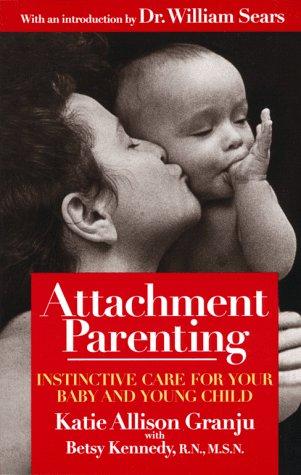
I'm on a quest to finish all of these book reviews, so please bear with me. This book was one that I read a while ago, about six months ago. Katie Allison Granju has done a marvelous job of compiling research for her book about attachment parenting. This was another "appeal to the nerd" book because, again, tons of quotes from doctors, parents, anthropologists, child development specialists, psychologists, etc.
This is definitely a book I would recommend to those who already are considering an "attachment parenting" lifestyle for them and their families rather than those who are being introduced to it for the first time (I'd recommend Dr. Sears's The Baby Book in those cases), mostly because of the passionate way she talks about attachment parenting (i.e. calling a crib a "baby cage" and carrying babies around in "baby buckets" such as car seats, swings, etc.). It would probably be a little much for an attachment parenting investigator. However, she does cover some parenting decision that aren't covered very thoroughly in The Baby Book including choices about circumcision, cloth diapering, how to choose a childcare provider or pediatrician, and extended breastfeeding. They're touched on in The Baby Book, but Granju goes into quite a bit of detail about these decisions.
If I was to have every mother read one chapter of this book, it would be the section on breastfeeding. She dispels myths about milk production (i.e. breasts need to "build up" milk so that baby has enough to eat, schedule feeding vs. cue feeding, and pumping as a way to increase milk production) and unloads a plethora of research about the benefits of breastfeeding. However, she also acknowledges that in a small percentage of cases, some women are physically unable to breastfeed, usually due to a medical problem (loss of too much blood during child birth, a hormonal imbalance, extreme stress, etc) and in these cases gives suggestion on how to "nurse" your bottle fed baby. I really liked how she addressed that breastfeeding is much more than the milk, it's a relationship, and that no matter what, a parent can have that relationship with their child.
A second "recommended chapter" would be the chapter on baby carriers. Again, there are a lot more types now than there were when this book was published, but she goes into the pros and cons of the basic carrier types (sling, front carrier, back carrier) and how to choose a baby carrier that is best suited for your needs.
Though she is quite zealous, she is very thorough and well thought-out. For example, I was on the fence about circumcising future sons, but Granju's section on circumcision (how it's unnecessary, the benefits of an intact penis, pain experienced during and after circumcision, etc.) certainly influenced me. Also, she includes literally hundreds of resources for parents including support groups, carrier types and manufacturers, breastfeeding help, and further reading. Since her book was published in 1999, I would love it if she revised and updated this book to include a "best of" list of resources since, obviously, the advent of the internet has significantly increased a parent's resources.
So, if you're curious about attachment parenting, opt for The Baby Book or Dr. Sears's The Attachment Parenting Book (it's more or less the "getting attached" section of The Baby Book with some added information). If you're pretty sure attachment parenting is the route for you and you want some added information about the benefits thereof, check out Attachment Parenting: Instinctive Care for Your Baby and Young Child by Katie Allison Granju.
Showing posts with label book review. Show all posts
Friday, December 9, 2011
Thursday, December 1, 2011
Book Review Three in a Bed: The Benefits of Sleeping with Your Baby
I really enjoyed reading Three in a Bed. It definitely appealed to the nerd within me as it had literally hundreds of quotes from cultural anthropologists, psychologists, medical doctors, professors, historical treatises on parenting, and the #1 experts--real parents. There was a quote on almost every single page pointing to the benefits of sleeping with your baby, babywearing, forgoing cry-it-out sleep training, breastfeeding, etc. It is written by Deborah Jackson, British mother of three, all of whom co-slept with her and her husband.
Jackson held traditional views about where a baby should sleep--in his crib, in his own room--until reading The Continuum Concept: In Search of Happiness Lost by Jean Liedorff. In a section of Liedorff's book, she speaks of her experience one night sleeping in the jungle among the natives of South America. At one point, all of the sleepers were awakened, one told a joke, they all laughed, and then went immediately back to sleep. There were no sleep troubles and every person was able to be roused, awakened, and fall back asleep without any problems whatsoever. In her study of this same group of natives, she found that within their culture, families slept together rather than separately, as is the custom in most of Western society. She concluded that a lot of our sleep problems in the West--from insomnia to general tiredness--have been created by our "laboratory style" sleep conditions including lights out, comfortable bed, quietness, and undisturbed sleep. As such, these laboratory sleep conditions may, in fact, be creating sleep problems rather than preventing them. And so, Jackson decided in the final weeks of pregnancy with her first child, to get rid of their assembled crib and bring Baby to bed with her and her husband.
Throughout the book, Jackson addresses a myriad of issues that face the co-sleeping family including the typical concerns about SIDS, overlaying, and general safety. She also addresses practical matters such as sexual intimacy between husband and wife (which, was one part of the book that I didn't really catch her fire. She basically subscribes to the thought that it's not that big of a deal if Baby is there, awake or asleep, and that it may even be healthy for babies and very young children to be privy to sexual exchanges between parents. Not really my cup of tea, personally but whatever floats your boat); how to wean from the family bed when desired; as well as the emotional, health, sociological, and psychological benefits to co-sleeping.
My personal favorite section was her chapter entitled "Nomads and Nannies" where she examines parenting practices across many cultures. She dispels the belief that all "uncivilized" and non-Western cultures are high-touch, co-sleeping, and nurturing. Instead, she gives example after example of gentle parenting practices in some cultures, and how they, in turn, produce a culture characterized as gentle, meek, and kind. In contrast, she gives mention to aggressive cultures that are highly disciplined, leave young babies to cry excessively (at one point, she talks about a culture that swaddles their babies and put them in a hanging basket on the wall except for when they are permitted to eat or to be changed), and who do not nurture and hold their babies. Jackson suggests that perhaps our aggressive Western culture spawns from low-touch, overly disciplined parenting practices. I think that's a little simplistic, but definitely some food for thought.
I would certainly recommend this book to anyone who has considered co-sleeping in their family. I do wish she had included a little more information about how to handle a few of the issues we're currently facing in our co-sleeping situation--i.e. Mr. Baby Bed Hog and how to prevent my arms from falling asleep when they're trying to avoid Mr. Baby Bed Hog. Again, I didn't agree or buy everything she had to say but overall, I found it to be very informative, enlightening, and thought-provoking book.
Happy Reading!
Thursday, October 20, 2011
Book Review: The Happiest Mom
Other than Dr. Sears's The Baby Book, I wish I had read this, and only this, book before becoming a mom. Here's why: So many baby books out there prescribe a set of rules and formulas, but Francis shares practical advice that will help to fill your confidence in yourself rather than questioning. Here's the premise: Happy moms have happy children. If you want the best for your kids, learn to be kind to yourself.
The Happiest Mom: 10 Secrets to Enjoying Motherhood is chalked full of practical advice and stories from a mom who has been there, done that. Her off-the-cuff humor had me chuckling, both in recognition and in anticipation for the great stories of motherhood to come. While her book is definitely aimed at mothers, her tips for enjoying motherhood are really tips for enjoying life--whether you're a mother or not.
Whether you're looking for ways to deal with busy-body moms in your playgroup, a messy kitchen that is getting under your skin, or feeling overwhelmed by all of your to-do list items, Francis has some pointers that will help just about any one. Best part? You'll feel good about yourself with every page. This ain't no "you're not doing good enough" book because, well, the message is about being happy, and guilt and happiness do not mix. Also, the book itself is beautiful. Colorful, doodle-full, and side-bar-full, you'll enjoy more than the words on the page. You'll enjoy just looking at it. If you're already a happy mom, The Happiest Mom will provide that pick-me-up on the hard days or at least lend a laugh in the meantime.
I actually liked this book so much that I've decided I would focus on implementing one of her secrets each month. Stay tuned!
Tuesday, July 19, 2011
Book review: Baby-led Weaning
I know I said I should lay off parenting books for a while but I was about done with this one so I thought I should post anyway. Please forgive me :)This book was so much fun and it made me really excited about starting solids with Hyrum. Here's the overall idea: Offer your baby safe, healthy foods and let them feed themselves. This thought 1) makes sense and 2) seems strange. We've all grown up with the idea of feeding little kiddos from a baby spoon and making airplane sounds to get them to open wide but this book squashes that notion as a necessity. Instead the authors suggest that babies develop self-feeding skills at the same rate their digestive tracts are able to handle the food and at the same rate that their bodies actually need solids. Here are a few of the general elements of baby-led weaning:
- Many people in our society have an unhealthy attitude toward food whether it be picky eating, eating disorders, or obesity. The authors suggest that these unhealthy attitudes may begin in infancy when children are spoon-fed food. Spoon feeding removes a child's control over what to eat and how much to eat. The authors suggest that instead, families should be eating healthy foods together, as a family, and the baby (as well as all members of the family) should be able to choose what and how much to eat.
- To allow your baby to feed himself, offer foods in manageable sizes. At 6 months, offer stick shapes because they pick food up with a palmar grasp and as they get older offer smaller pieces they can pick up with pinchers, offer child-sized silverware as they grow so they learn to use it as they're ready, etc.
- To do baby-led weaning safely, never put food in your child's mouth. Babies can, when given appropriate foods in appropriate shapes to their development, handle it safely on their own. But, when food is put in their mouths for them, they no longer have the control over the food and the baby is more likely to choke.
- Babies who feed themselves and are allowed to touch, hold, examine, drop, smoosh, etc. learn about food and also learn many other different things like cause and effect, gravity, how to handle different textures, etc.
- Solid foods should not begin until 6 months old because this is 1) when their digestive tracts are ready and 2) when they can self-feed. This point was actually a big seller for me. One doctor will say four months, another six months, and another whenever they seem interested. It made sense to me that a baby's body was ready for solids as they became ready to handle them in other aspects.
- Milk feedings should remain the sole source of nutrients up to six months old and should be the main source of nutrients until at least12 months old. The authors point out that introducing solids before 6 months can cause an early decrease in the mother's milk supply. Since breast milk or formula are far more nutrient-packed than cereals and other baby foods, babies below 6 months should have more breast milk or formula if they are acting hungrier or waking at night, rather than starting solids before the 6-month mark. They also point out that babies who seem interested in solids are actually just interested in just about everything. Curiosity is not a sign of readiness (kind of reminds me of the church's position on receiving temple covenants).
- Babies should be allowed to exercise control over their food--both by feeding breastmilk on demand and by not forcing a baby to eat solids that they don't want to eat. This helps to create a healthier relationship with food, cuts down on mealtime tantrums, and allows baby to learn appetite control.
- Babies only start to need solids at 6 months. Even though they're mostly playing and not eating much at first, as long as they're still having plenty of milk feedings and being offered nutritious foods at every meal, they're getting enough to eat.
Overall, I really liked this concept. I've watched too many kiddos who won't even touch something they've never tried before and I don't doubt it's because they weren't allowed to explore many different foods as a baby and young child. I also really like how it goes against the whole idea of an outside institution (especially baby food companies. I'm just not a huge fan of most of them) deciding what and how much your child should eat.
We've been doing baby-led weaning with Hyrum for a couple of weeks now and it is so much fun and so easy. We just give him what we're eating and he tries just about everything. Even if he makes the "gag" face like he doesn't like it, he still goes back for another try. Thus far, I'm pretty convinced and we're all having a good time. Best part, because we're giving baby what we eat, we're all eating healthier too
Labels:
book review,
breastfeeding,
nutrition and feeding,
weaning
Sunday, June 12, 2011
Book Review: The No-cry sleep solution

I was easily drawn to this book because of it's no-nonsense title. It tells you exactly what the plan is from the get-go: get your kid to sleep without having to "cry it out." It's kind of refreshing after all of the other baby sleep books with titles that sound like they're going to deliver, but then you find out that it's just another proponent of the tired, old "cry it out" advice--new title, different packaging, same message.
However, before presuming that this book is going to solve all of your problems, there are a few things to keep in mind:
- This plan is going to take time. Many of the other baby sleep plans suggest that their methods will only take 3-5 days. This plan truly will take 1-3 months to see the results you're searching for. Good news is that the author tells you this from the very beginning so there are no surprises.
- She's an attachment parenting mama. For me, that's wonderful. I really agree with a lot of the philosophies and practices behind attachment parenting. In fact, I even credit this book for helping to solidify some of my thoughts on parenting. But, if attachment parenting really isn't your thing, this book might not be for you.
- "Sleeping through the night" is defined by the medical definition of 5 consecutive hours of nighttime sleep. She promises that by following and adjusting your personal sleep plan, you can help your baby to achieve this milestone. If you're looking for a plan this promises 12 hours of consecutive sleep by next week, again, probably not for you.
PROS
- Proper perspective. The author writes from the perspective of a mother. The large majority of sleep books are based on charts, faceless statistics, and graphs. This book is written by a mother who implemented these sleep strategies with her own children and oversaw their implementation with a large number of test-mommies and babies.
- Informative. Contains a lot of information about sleep facts and sleep needs for babies, children, and adults. Her research is well-founded and well-documented.
- Personalized approach. A large number of suggestions are given and families are instructed to develop their own, personalized sleep plan based off of these suggestions. This allows families to pick and choose those things that are possible for them and options they feel the most comfortable with (see the con associated with this). She also clearly marks which suggestions are geared toward crib vs. co-sleeping and breast vs. bottle feeding babies.
- Reasonable approach. Throughout the book, she constantly reminds families, "if you're getting frustrated or you just can't do it tonight, try next time." Also, for those parents who are dangerously sleep deprived or otherwise unable to follow their prescribed sleep plans, she gives some great suggestions to ensure a more gentle approach should you chose to "cry-it-out."
- Parenting philosophy. As I mentioned before, she's an attachment mama. If that's not your cup of tea, this book may come across as "preachy."
- Overwhelming number of suggestions. Since there are a large number of sleep solutions, some families may become overwhelmed by all of the options and may try all of them at once. This may lead to burn-out.
- Time. This program takes weeks to months of implementation before results (large or small) may be seen. For dangerously sleep-deprived families, this may be too long of a time for safety reasons.
- Anxiety inducing. Maybe this one is just for me, but she suggests keeping track of your baby's sleep every 10 or more days. For me, it just made me more anxious about my baby's night wakings.
- Less sleep now. No matter what sleep solution you choose, cry-it-out or otherwise, this solution may result in less sleep for mom (or dad) while the sleep solutions are being implemented
One of the main things that I really appreciated is how reasonable the author is. So many books present "if you don't do it my way, your kid is going to have problems forever" mentality. This book is not one of them. The author acknowledges that parents have choices and those choices do have consequences; but for the most part, you're not going to destroy your child. In fact, from the get-go she talks to parents about their willingness to give up the night wakings. For some people (me included), they're really not a big deal and are even enjoyed at times. That being considered, we've made the choice to implement some suggestions but not worry too much about it. For the most part, our baby is sleeping better. He still wakes a few times a night but that's definitely manageable.
For me, the best part about this book was how I walked away with greater perspective. The author presents it as a book about helping your baby to sleep better, not a parenting program. As such, I've been able to see sleep as just one component of my life and my baby's life. My foremost goals for my baby are to help him feel secure, loved, and respected. This book helped me to see that I can hold true to those goals while still working towards a full-night's sleep.
Subscribe to:
Posts (Atom)