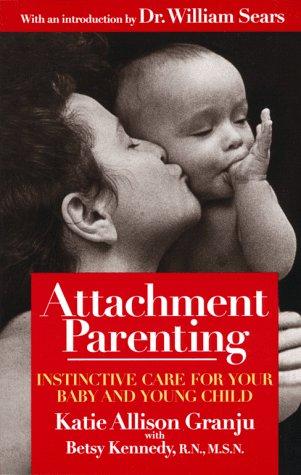
I'm on a quest to finish all of these book reviews, so please bear with me. This book was one that I read a while ago, about six months ago. Katie Allison Granju has done a marvelous job of compiling research for her book about attachment parenting. This was another "appeal to the nerd" book because, again, tons of quotes from doctors, parents, anthropologists, child development specialists, psychologists, etc.
This is definitely a book I would recommend to those who already are considering an "attachment parenting" lifestyle for them and their families rather than those who are being introduced to it for the first time (I'd recommend Dr. Sears's The Baby Book in those cases), mostly because of the passionate way she talks about attachment parenting (i.e. calling a crib a "baby cage" and carrying babies around in "baby buckets" such as car seats, swings, etc.). It would probably be a little much for an attachment parenting investigator. However, she does cover some parenting decision that aren't covered very thoroughly in The Baby Book including choices about circumcision, cloth diapering, how to choose a childcare provider or pediatrician, and extended breastfeeding. They're touched on in The Baby Book, but Granju goes into quite a bit of detail about these decisions.
If I was to have every mother read one chapter of this book, it would be the section on breastfeeding. She dispels myths about milk production (i.e. breasts need to "build up" milk so that baby has enough to eat, schedule feeding vs. cue feeding, and pumping as a way to increase milk production) and unloads a plethora of research about the benefits of breastfeeding. However, she also acknowledges that in a small percentage of cases, some women are physically unable to breastfeed, usually due to a medical problem (loss of too much blood during child birth, a hormonal imbalance, extreme stress, etc) and in these cases gives suggestion on how to "nurse" your bottle fed baby. I really liked how she addressed that breastfeeding is much more than the milk, it's a relationship, and that no matter what, a parent can have that relationship with their child.
A second "recommended chapter" would be the chapter on baby carriers. Again, there are a lot more types now than there were when this book was published, but she goes into the pros and cons of the basic carrier types (sling, front carrier, back carrier) and how to choose a baby carrier that is best suited for your needs.
Though she is quite zealous, she is very thorough and well thought-out. For example, I was on the fence about circumcising future sons, but Granju's section on circumcision (how it's unnecessary, the benefits of an intact penis, pain experienced during and after circumcision, etc.) certainly influenced me. Also, she includes literally hundreds of resources for parents including support groups, carrier types and manufacturers, breastfeeding help, and further reading. Since her book was published in 1999, I would love it if she revised and updated this book to include a "best of" list of resources since, obviously, the advent of the internet has significantly increased a parent's resources.
So, if you're curious about attachment parenting, opt for The Baby Book or Dr. Sears's The Attachment Parenting Book (it's more or less the "getting attached" section of The Baby Book with some added information). If you're pretty sure attachment parenting is the route for you and you want some added information about the benefits thereof, check out Attachment Parenting: Instinctive Care for Your Baby and Young Child by Katie Allison Granju.
Showing posts with label breastfeeding. Show all posts
Friday, December 9, 2011
Saturday, August 20, 2011
How breastfeeding changed my life
I was chatting with my friend Kim the other day, another young mom in our ward who shares a lot of the same thoughts and philosophies I do. Truth be told, Kim is kind of one of my heroes. Natural-eating, co-sleeping, home birth mama with a beautiful bond and attachment to her baby girl. She shared with me some of her struggles with breastfeeding in the early months of her baby's life. As she told me some of the things that she had to do to continue breastfeeding I thought, "Goodness, I wonder if I would have gone through all of the trouble."
I absolutely love breastfeeding. I love how Hyrum will snuggle in. I love how it calms him when he's upset. I love how he gets so excited for our nursing sessions. I even love how rambunctious he's getting when he nurses. It just reminds me of how the breastfeeding relationship is constantly developing, constantly changing. In the early days you wonder if you'll ever move from the chair and then suddenly one day your nursing sessions are down to 5-10 minutes. They go from being cuddly to kicky, from lying to sitting. I just think it's amazing to watch the relationship mirror the baby's learning and growing.
And yet I think back to my early days of Hyrum's life. I'm pretty sure if it had been much of a struggle I would have thrown in the towel. I just wasn't committed enough. Truth be told, I was terrified of breastfeeding. Not on a philosophical level, just terrified that I wouldn't be able to figure it out. Thankfully, breastfeeding was not one of those things that came with difficulty for Hyrum and me. I thank Heavenly Father for that blessing because honestly, breastfeeding has changed my life.
Because I loved breastfeeding so much and it felt so natural, I began questioning some of the things I had read/learned/heard/thought about infant care. Because breastfeeding came easily, I transitioned from wanting to schedule feed to demand feed. Because I started feeding on demand, I found breastfeeding to be more than just food but also a time of comfort and cuddles for both my baby and mommy. Because breastfeeding was established, I desired to learn about other natural ways of living, including birthing. Because I breastfed and wanted to make my life a little easier, I moved our baby from the crib to our bed. Because I moved him to our bed, my husband and I have had some wonderful bonding moments as a whole family. Because I wanted my breastfed baby to grow up healthy and strong, I started taking better care of my own body. Because I wanted to take better care of my body I started eating healthy foods and exercising. Because I eat healthy foods and exercise, I have more energy and find greater enjoyment in my life. Because I love breastfeeding so much, I joined a La Leche League and met many wonderful mothers who live in my city. Because I met other moms, Calgary is starting to feel more and more like home. Because it feels more and more like home, I feel happy. '
And so now I realize that Heavenly Father provided me with a beautiful gift. If, for me, breastfeeding had been quite difficult in the beginning, I probably would have given up. But, if I had given up, I wonder how different my life would be today. I really like my life just as it is now. A number of things have changed, a lot have stayed the same, but I like the changes. I like how breastfeeding has changed my life.
How has breastfeeding affected your life?
Sunday, August 14, 2011
A feminist questions the hegemony behind no co-sleeping
I guess you could call me a feminist. It's hard to embrace that term when it has such a negative connotation. You know, the bra burners of the 60s and such. That's all anyone thinks about. Never mind that feminism began with women winning the vote, wearing pants, women attending college, and reproductive rights. Even those who shrink at the word "feminist" believe that it's okay for women to wear a pair of blue jeans, cast a vote, obtain a college degree, and take a birth control pill if she wants to. But whatever. We can keep thinking the word is dirty if that is desired. But for the record, I wear pants. And I went to college. I vote. And, well, I've taken birth control in my life.
So, let's take it I'm a feminist and go from there.
I don't like men telling me how to be a woman. Period. As a mom who loves to read about parenting, I've noticed how many parenting books out there --almost exclusively aimed at the mother--are written by men. And not surprisingly, most of them are aimed at sleeping. Oh sleep...it seems as if that's all anyone can talk about when it comes to babies and young children. "Is he sleeping through the night?" "Are you sleep training him?" "How did he sleep last night?" "Does he take good naps?" To be honest, it kind of drives me batty. In fact, it's gotten to the point where I've started telling people that yes, he does sleep through the night. Because guess what, he does sleep during the night. Maybe not without waking for a little bit of comfort but he surely does sleep through the night.
And then I started wondering, why is this such a big deal to people? Here's where I pull out my feminist card...male authors. With few exceptions (i.e. the Sears family doctors) most male authors place enormous weight on sleep (Ezzo, Weissbluth, Ferber)--how long, how they get to sleep, and most importantly, where they sleep.
Is it that big of a surprise that male authors would be the ones to suggest moving the baby to his own bed, in his own room? While there's a baby there he's got to be a little more creative to get some action between the covers. So the simply solution is obviously to move the baby to his own bed, in his own room, and to help mothers feel better about it, they use the word "safety."
Whether you're a co-sleeper or not, it ain't hard to see where all of the fuel for solitary sleeping is coming from. After analyzing the statistics, as much as many pediatricians will give a thumbs down to co-sleeping, your baby actually has a higher chance of survival in the night if he's in your bed rather than in a crib. (Statistics gathered in 1997 suggest that while 515 infants died of "overlaying" in an adult bed, 2705 died of SIDS--the large majority of which were sleeping solitary). And yet, sleeping with your infant or young child is scolded, something that many families do but don't tell because if your kid sleeps with you, you're a "bad parent."
But here's the thing, families across the world have been sleeping with their infants for thousands of years. Why? Most white Americans say it's a cultural decision. People from "other cultures" do it, but we're above that. We should note that white American (mostly males) were also the ones to say that infant formula (which used to be nothing more than flour mixed with water and perhaps a little bit of cow's milk) was superior to breast milk. Throughout the 18th-early 20th centuries, women were told to feed their babies on schedules. When their milk supply slowly dropped, they had the advantage of turning to the "superior" infant formulas. Again, men were telling women how to feed their children when for thousands of years they had been doing just fine. However, with the turn to infant formula, the adult male, not the baby, was the owner of the woman's body.
Since we've been able to acknowledge that the "experts" of the past were incorrect about breastfeeding, why is it that we haven't acknowledged that they are also incorrect regarding the location of baby in the nighttime? If you talk to most (by choice) co-sleeping mothers they'll tell you they love the feel of their baby next to them. They love waking in the morning to her family being together. She'll tell you it feels natural and wonderful. She'll more than likely tell you that she's well-rested. Hmmm...sleep for all, feels natural, allows for the continuation of the breastfeeding relationship...sounds like a positive thing to me.
If nothing else, I'm curious as to how this will pan out in 50-100 years. Will our grandchildren look back on our time the way we look back at the advice of doctors of the 1940s and 50s? A time when they told women their breasts were too small to breastfeed? A time when they told women to feed on a strict 4 hour schedule for the good of the baby and themselves? Will our children's children have the information that proves that what families have been doing for hundreds of thousands of years is safest? I'm curious to watch.
Tuesday, July 19, 2011
Book review: Baby-led Weaning
I know I said I should lay off parenting books for a while but I was about done with this one so I thought I should post anyway. Please forgive me :)This book was so much fun and it made me really excited about starting solids with Hyrum. Here's the overall idea: Offer your baby safe, healthy foods and let them feed themselves. This thought 1) makes sense and 2) seems strange. We've all grown up with the idea of feeding little kiddos from a baby spoon and making airplane sounds to get them to open wide but this book squashes that notion as a necessity. Instead the authors suggest that babies develop self-feeding skills at the same rate their digestive tracts are able to handle the food and at the same rate that their bodies actually need solids. Here are a few of the general elements of baby-led weaning:
- Many people in our society have an unhealthy attitude toward food whether it be picky eating, eating disorders, or obesity. The authors suggest that these unhealthy attitudes may begin in infancy when children are spoon-fed food. Spoon feeding removes a child's control over what to eat and how much to eat. The authors suggest that instead, families should be eating healthy foods together, as a family, and the baby (as well as all members of the family) should be able to choose what and how much to eat.
- To allow your baby to feed himself, offer foods in manageable sizes. At 6 months, offer stick shapes because they pick food up with a palmar grasp and as they get older offer smaller pieces they can pick up with pinchers, offer child-sized silverware as they grow so they learn to use it as they're ready, etc.
- To do baby-led weaning safely, never put food in your child's mouth. Babies can, when given appropriate foods in appropriate shapes to their development, handle it safely on their own. But, when food is put in their mouths for them, they no longer have the control over the food and the baby is more likely to choke.
- Babies who feed themselves and are allowed to touch, hold, examine, drop, smoosh, etc. learn about food and also learn many other different things like cause and effect, gravity, how to handle different textures, etc.
- Solid foods should not begin until 6 months old because this is 1) when their digestive tracts are ready and 2) when they can self-feed. This point was actually a big seller for me. One doctor will say four months, another six months, and another whenever they seem interested. It made sense to me that a baby's body was ready for solids as they became ready to handle them in other aspects.
- Milk feedings should remain the sole source of nutrients up to six months old and should be the main source of nutrients until at least12 months old. The authors point out that introducing solids before 6 months can cause an early decrease in the mother's milk supply. Since breast milk or formula are far more nutrient-packed than cereals and other baby foods, babies below 6 months should have more breast milk or formula if they are acting hungrier or waking at night, rather than starting solids before the 6-month mark. They also point out that babies who seem interested in solids are actually just interested in just about everything. Curiosity is not a sign of readiness (kind of reminds me of the church's position on receiving temple covenants).
- Babies should be allowed to exercise control over their food--both by feeding breastmilk on demand and by not forcing a baby to eat solids that they don't want to eat. This helps to create a healthier relationship with food, cuts down on mealtime tantrums, and allows baby to learn appetite control.
- Babies only start to need solids at 6 months. Even though they're mostly playing and not eating much at first, as long as they're still having plenty of milk feedings and being offered nutritious foods at every meal, they're getting enough to eat.
Overall, I really liked this concept. I've watched too many kiddos who won't even touch something they've never tried before and I don't doubt it's because they weren't allowed to explore many different foods as a baby and young child. I also really like how it goes against the whole idea of an outside institution (especially baby food companies. I'm just not a huge fan of most of them) deciding what and how much your child should eat.
We've been doing baby-led weaning with Hyrum for a couple of weeks now and it is so much fun and so easy. We just give him what we're eating and he tries just about everything. Even if he makes the "gag" face like he doesn't like it, he still goes back for another try. Thus far, I'm pretty convinced and we're all having a good time. Best part, because we're giving baby what we eat, we're all eating healthier too
Labels:
book review,
breastfeeding,
nutrition and feeding,
weaning
Wednesday, July 13, 2011
My rant about weaning
I made a boo-boo today. I mentioned to a couple gals who don't have kids that I plan on breastfeeding my baby past the first year. They kind of gave me that, "ummm, you're weird" look. Maybe it's me that is in the dark here but I don't really understand why people think that's so strange. I guess, come to think of it, I used to think it was strange too. But now that I have a baby and have learned so much about the amazing benefits of breastfeeding, it just seems normal. In fact, the current WHO recommendation is to breastfeed your baby until at least 2 years of age. This is for numerous reasons but one of the main ones being the benefits to a child's immune system, which is still quite underdeveloped until around the age of two.
So here's the real question, why doesn't anyone look at a mother strangely for giving her child cow's milk at age one? Cow's milk was meant for cow babies but for some reason that is kosher, but feeding a human child milk that was meant for human babies is strange. What gives?
If you look at infant feeding around the globe, many children do not wean until close to their third, fourth, or even fifth birthday. But in North America and in some parts of Europe, that seems absolutely insane. If you look at trends across the animal kingdom, most other mammals don't wean until they have at least quadrupled their birth weight. If a human mother were to nurse her baby until he quadrupled his birth weight she would likely nurse her baby until an average of 3 years of age.
So why one year old? Doesn't that seem kind of arbitrary when you think about it? Children are considered babies until they reach their second birthday, so why are we in such a rush to move them out of the baby stage and make them grow up before their time. Don't children deserve to be children?
And what about allowing your child to decide when they are ready to give up nursing? One can assume that if there were no arbitrary guidelines or societal pressures surrounding breastfeeding and weaning, most likely the baby would be the one to set the pace. And really, why not have it be that way? In fact, a mother's milk supply is meant to sustain her child at the rate that he feeds. God created a woman's body so that she could produce milk until her baby stopped sucking at the breast, so why don't we follow that?
I'm not saying everyone needs to nurse their baby past the first year but when you look at breastfeeding around the globe, across the animal kingdom, in conjunction with the child-human's immune and digestive system, and the mother's continued ability to produce breastmilk indefinitely, the idea of "You're one, you're done" is what seems strange. In fact, from what I can ascertain, any limits that have been put on breastfeeding (i.e. scheduled feeding, weaning age, etc.) all began with uninformed male physicians in the 1920s and 1930s who knew little to nothing about maternal lactation--the same men who told women with small breasts that they wouldn't be able to produce enough milk and who pushed women to use infant formula because it was better for babies than breastmilk. However, you ask a lactation consultant, someone who has actually been trained in the intricacies of maternal lactation, and she'll advocate on-demand feeding and breastfeeding past the first year. So, why aren't the real experts voices being heard? Why are we still listening to the uninformed, uneducated voices of the past?
I guess that's everyone's choice. But, please don't frown down on me because I choose not to.
Thursday, June 23, 2011
Why I took on "Attachment Parenting"
(I don't know how I'll possibly be able to talk about this in one post. There are so many advantages to attachment parenting that I'll likely make separate posts about many of its principles in the future, but here is a quick run down)
I've had a number of people ask me, "so, what is attachment parenting?" or "Why do you do that?" Attachment parenting was a phrase coined by Dr. William Sears who explains it as a style of parenting that most of us would do if there were no baby books written. I'm not 100% sure about that for everyone, but for me, it's very likely true. In a nutshell, attachment parenting is making choices that help you to know your baby best and therefore be better suited to follow their cues. Some of the common choices of attachment parents are: "on-cue" feeding (breastfeeding whenever possible), co-sleeping, babywearing, child-respectful weaning, and overall just loving your baby. You don't have to do all of those things to be an "attachment parent" (well, minus the loving your baby thing!), but they really help you to know your baby. Of course, individual application advised and necessary. If you're interested in attachment parenting, your best resources is The Baby Book by Dr. William and Martha Sears.
So, why attachment parenting for me? Well, that's a little bit of a journey. My baby Hyrum was brought into this world with an epidural, a bassinet, a stroller, disposable diapers, and I was committed to breastfeeding as long as it worked. I wanted to give birth without an epidural but figured I didn't have it in me. I was pretty sure co-sleeping would wreck a marriage. While I had a Moby Wrap from the beginning and planned on using it extensively, I was turned off by comments I'd read about "sling wearing" parents who were basically destroying their children's lives. And, I was scared about breastfeeding while in school.
Then, little by little, things changed. Breastfeeding felt like the most natural thing in the world. I had intentions of getting my baby "on a schedule" and had even been told by one of my favorite profs that my baby was "manipulating" me to be held more. What a load! At the time though, I was sure she must know more than me. So, I started to worry. I started pulling back from my baby, worrying that he was truly "manipulating" me, and moved him to the crib in the next room.
And then it hit me one day. I was sitting alone with my baby and I had this terrifying thought, "I don't know how to tell when you're hungry or tired anymore! I used to know but now I don't!" I'm not joking--I really did have this thought. One thing I did know for sure, I didn't want to let my baby cry to sleep. I just didn't have the heart for it. One day I was browsing on the internet for baby sleep books and came across one called, "The No-cry Sleep Solution." I thought, now that's my kind of baby book!
I checked it out from the library and in the section about babies under four months of age, she includes some references. Two of which were Attachment Parenting by Katie Allison Garanju and The Baby Book by Dr. William Sears. I checked out The Baby Book from the BYU library and began learning about the principles of attachment parenting. Back up a couple months and the ONLY exposure I had to attachment parenting was from a book called On Becoming Babywise which, in short, isn't a big fan of attachment style parenting. (We should note that while I was reading this book I had two thoughts, "This attachment parenting thing sound awful" and "this attachment parenting thing sound amazing.") I was a little torn. Now what to do...
Well, I did what any sensible person would do. I put it on hold. I was in the middle of trying to finish up my graduate degree and was remarkably insecure as a new mom. I just didn't want to deal with it right then. So I didn't.
About the time that we were moving to Canada, I found myself with a lot more time on my hands. I started reading. Internet sites, child development materials, Dr. Sears's book, and talking with other moms. The main draw for me: Attachment parents were absolutely in love with their children. They had great marriages; healthy, thriving babies; and were remarkably confident in their parenting. Now that's the kind of mom I wanted to be! I was tired of worrying if I was doing things right. I was tired of worrying that my baby wasn't like all of the babies I had read in other books. I was tired of not believing that I knew what was best for my baby.
After some visits with our pediatrician, I was filled with confidence that our cue-fed baby was developing beautifully and was in excellent physical condition (isn't it great that rolly polly is great condition?) so I figured, "why not give this a shot?!"
During the move, I consistently co-slept with Hyrum because I figured it was best with all of the different living spaces to always have one constant--me! When we moved into our apartment in Calgary, we tried to put him in the crib and he just wouldn't take it. Brennan and I had some discussions about what we thought was best and we decided the following things were important to us: couple time, quality sleep, and not crying it out. So we concocted our own way of doing things--musical beds. Hyrum sleeps in his crib for the first part of the night and we bring him to bed with us after the first night feeding. It's been a glorious way for us to have the best of all worlds. Nothing is sweeter to me than seeing my husband cuddle with our baby in the morning when we wake up. Tellin' ya girls,a man is never so attractive as when he is being so wonderful and gentle with a baby.
Next up was babywearing. This one mostly came out of convenience. We have etched concrete floors in the main part of our new apartment. Even by putting a blanket down on them, they're awfully hard. I don't really like putting Hyrum down on them and if I need to do something in the kitchen, I don't like leaving him at the other end of the house by himself. The Moby Wrap became my best friend. Also, since we live in a basement apartment, I absolutely hate dragging that stroller up our narrow stairs. I do from time to time but if I don't have to, then I figure why do it?
On-cue breastfeeding was something we were already doing. I tried scheduling Hyrum when he was a new baby and it just didn't feel right so I stopped. So, not much change there.
As far as weaning goes, we're just not there yet. I thought about introducing solids at 4 months but after doing some research, we decided to wait until at least 6 months. Hyrum does show interest in solids but he basically shows interest in just about anything that could (or couldn't) go in his mouth so I figured that wasn't a good enough of a reason and by feeding on-cue, his body doesn't need solids to stay full.
There are the individual choices but added up, the main reason I "do" attachment parenting is because I feel so much more confident in my parenting. I feel like I know my baby so well and know how to make choices that are good for him and for me. Though I thought this way of parenting would feel too "baby centered" (which is definitely what it sounds like), I actually have such a wonderful relationship with Hyrum now that I feel privileged to spend this kind of time on him. In fact, applying the principles of attachment parenting has really helped with my postpartum depression. I feel much more confident and "whole."
Now here's the big question: Am I spoiling him? I don't think so. For one, across the board, child development specialists agree that you can't spoil a child in the first year of life. Needs and wants are the same thing and that by helping them to meet their needs now, they will be more independent as they grow. Also, I really like a quote from Dr. Sear's book that basically says that spoiling is something we do when we leave food on a shelf to rot. I think the only way I could spoil him is if I replace what he really needs (loving parents, human interactions, touch, etc.) with things. By spending time on him rather than relying on a ton of toys to entertain him, I feel that I'm teaching him what really matters in this world--people, relationships, and his family. And that's why I'm an attachment parent.
Labels:
attachment parenting,
babywearing,
bonding,
breastfeeding,
co-sleep
Monday, June 13, 2011
Nursing in public
As a mom to a 2-3 month old baby, I could easily cover up. No big deal at all. He almost seemed to like being snuggled in and warm. But now he's a bit older and much more curious and he absolutely hates having a nursing cover over his head. I even have one of those fancy bebe au lait covers with the boning so I can see him but still, no go.
I used to wonder why women made such a big deal about being made to cover up in public. I figured it wasn't that big of a deal so why create a stir? Well, here are a few reasons:
1) Curious babies. Once babies get to a certain age, they want to be able to see what's going on around them. Think about yourself and your morning bowl of cereal. Do you focus intently on your bowl of cereal and nothing else? No! You look around, read the cereal box, talk to someone at the table with you, read the paper, etc.
2) Comfort. I get hot just putting it over myself but can you imagine if your head and face were covered? No wonder the kiddos don't want it over their heads. They're too stinkin' hot!
3) Rude? Why in the world do we feel it is rude to see a baby nursing? Frankly, I've been at the table with much worse before. Try sitting next to someone who eats with their mouth open. Disgusting. But, no one goes up to them and asks them to please put a cover over their heads. Tell you what, when no one talks with their mouth open anymore, I'll consider thinking its rude for my child to be seen eating in public.
4) Modesty. Isn't that the main argument? That it's immodest? Please tell me why we tolerate low-cut shirts and Victoria Secret advertisements but we can't tolerate a woman nursing her baby in open. I think a lot of it actually has to do with male misogyny. Wildly attractive woman showing off her breasts versus an average-looking woman using hers for a natural purpose. One doesn't need to think too long about that. Also, I don't know about anyone else, but I almost feel as if I'm showing off more by having my baby pull the cover up than I would if I just nursed him openly.
5) Good example. Nursing in public shows others, hopefully young women and girls, that nursing is natural and a desirable thing to do. In fact, I love the idea of nursing dolls. I think we should eliminate bottle feeding dolls and show young girls that nursing is what mommies do.
But, that being said, I still cover up in public. I wish I had the courage to just nurse anytime, anywhere but to be honest, I get scared. I don't think there is anything wrong with it at all. In fact, I think we should be nursing openly. Anyone want to join me on a crusade to make it okay? How would one go about doing that without being labeled as "subversive?"
Subscribe to:
Posts (Atom)