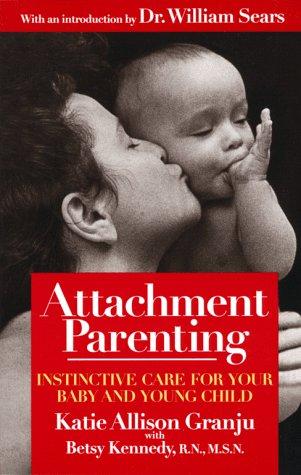
I'm on a quest to finish all of these book reviews, so please bear with me. This book was one that I read a while ago, about six months ago. Katie Allison Granju has done a marvelous job of compiling research for her book about attachment parenting. This was another "appeal to the nerd" book because, again, tons of quotes from doctors, parents, anthropologists, child development specialists, psychologists, etc.
This is definitely a book I would recommend to those who already are considering an "attachment parenting" lifestyle for them and their families rather than those who are being introduced to it for the first time (I'd recommend Dr. Sears's The Baby Book in those cases), mostly because of the passionate way she talks about attachment parenting (i.e. calling a crib a "baby cage" and carrying babies around in "baby buckets" such as car seats, swings, etc.). It would probably be a little much for an attachment parenting investigator. However, she does cover some parenting decision that aren't covered very thoroughly in The Baby Book including choices about circumcision, cloth diapering, how to choose a childcare provider or pediatrician, and extended breastfeeding. They're touched on in The Baby Book, but Granju goes into quite a bit of detail about these decisions.
If I was to have every mother read one chapter of this book, it would be the section on breastfeeding. She dispels myths about milk production (i.e. breasts need to "build up" milk so that baby has enough to eat, schedule feeding vs. cue feeding, and pumping as a way to increase milk production) and unloads a plethora of research about the benefits of breastfeeding. However, she also acknowledges that in a small percentage of cases, some women are physically unable to breastfeed, usually due to a medical problem (loss of too much blood during child birth, a hormonal imbalance, extreme stress, etc) and in these cases gives suggestion on how to "nurse" your bottle fed baby. I really liked how she addressed that breastfeeding is much more than the milk, it's a relationship, and that no matter what, a parent can have that relationship with their child.
A second "recommended chapter" would be the chapter on baby carriers. Again, there are a lot more types now than there were when this book was published, but she goes into the pros and cons of the basic carrier types (sling, front carrier, back carrier) and how to choose a baby carrier that is best suited for your needs.
Though she is quite zealous, she is very thorough and well thought-out. For example, I was on the fence about circumcising future sons, but Granju's section on circumcision (how it's unnecessary, the benefits of an intact penis, pain experienced during and after circumcision, etc.) certainly influenced me. Also, she includes literally hundreds of resources for parents including support groups, carrier types and manufacturers, breastfeeding help, and further reading. Since her book was published in 1999, I would love it if she revised and updated this book to include a "best of" list of resources since, obviously, the advent of the internet has significantly increased a parent's resources.
So, if you're curious about attachment parenting, opt for The Baby Book or Dr. Sears's The Attachment Parenting Book (it's more or less the "getting attached" section of The Baby Book with some added information). If you're pretty sure attachment parenting is the route for you and you want some added information about the benefits thereof, check out Attachment Parenting: Instinctive Care for Your Baby and Young Child by Katie Allison Granju.
Showing posts with label co-sleep. Show all posts
Friday, December 9, 2011
Thursday, December 1, 2011
Book Review Three in a Bed: The Benefits of Sleeping with Your Baby
I really enjoyed reading Three in a Bed. It definitely appealed to the nerd within me as it had literally hundreds of quotes from cultural anthropologists, psychologists, medical doctors, professors, historical treatises on parenting, and the #1 experts--real parents. There was a quote on almost every single page pointing to the benefits of sleeping with your baby, babywearing, forgoing cry-it-out sleep training, breastfeeding, etc. It is written by Deborah Jackson, British mother of three, all of whom co-slept with her and her husband.
Jackson held traditional views about where a baby should sleep--in his crib, in his own room--until reading The Continuum Concept: In Search of Happiness Lost by Jean Liedorff. In a section of Liedorff's book, she speaks of her experience one night sleeping in the jungle among the natives of South America. At one point, all of the sleepers were awakened, one told a joke, they all laughed, and then went immediately back to sleep. There were no sleep troubles and every person was able to be roused, awakened, and fall back asleep without any problems whatsoever. In her study of this same group of natives, she found that within their culture, families slept together rather than separately, as is the custom in most of Western society. She concluded that a lot of our sleep problems in the West--from insomnia to general tiredness--have been created by our "laboratory style" sleep conditions including lights out, comfortable bed, quietness, and undisturbed sleep. As such, these laboratory sleep conditions may, in fact, be creating sleep problems rather than preventing them. And so, Jackson decided in the final weeks of pregnancy with her first child, to get rid of their assembled crib and bring Baby to bed with her and her husband.
Throughout the book, Jackson addresses a myriad of issues that face the co-sleeping family including the typical concerns about SIDS, overlaying, and general safety. She also addresses practical matters such as sexual intimacy between husband and wife (which, was one part of the book that I didn't really catch her fire. She basically subscribes to the thought that it's not that big of a deal if Baby is there, awake or asleep, and that it may even be healthy for babies and very young children to be privy to sexual exchanges between parents. Not really my cup of tea, personally but whatever floats your boat); how to wean from the family bed when desired; as well as the emotional, health, sociological, and psychological benefits to co-sleeping.
My personal favorite section was her chapter entitled "Nomads and Nannies" where she examines parenting practices across many cultures. She dispels the belief that all "uncivilized" and non-Western cultures are high-touch, co-sleeping, and nurturing. Instead, she gives example after example of gentle parenting practices in some cultures, and how they, in turn, produce a culture characterized as gentle, meek, and kind. In contrast, she gives mention to aggressive cultures that are highly disciplined, leave young babies to cry excessively (at one point, she talks about a culture that swaddles their babies and put them in a hanging basket on the wall except for when they are permitted to eat or to be changed), and who do not nurture and hold their babies. Jackson suggests that perhaps our aggressive Western culture spawns from low-touch, overly disciplined parenting practices. I think that's a little simplistic, but definitely some food for thought.
I would certainly recommend this book to anyone who has considered co-sleeping in their family. I do wish she had included a little more information about how to handle a few of the issues we're currently facing in our co-sleeping situation--i.e. Mr. Baby Bed Hog and how to prevent my arms from falling asleep when they're trying to avoid Mr. Baby Bed Hog. Again, I didn't agree or buy everything she had to say but overall, I found it to be very informative, enlightening, and thought-provoking book.
Happy Reading!
Wednesday, August 17, 2011
Sex and co-sleeping
I'm not really going to give a lengthy response to the issue of sexual intimacy and co-sleeping. I think this sums up all of my thoughts pretty well.
Sunday, August 14, 2011
A feminist questions the hegemony behind no co-sleeping
I guess you could call me a feminist. It's hard to embrace that term when it has such a negative connotation. You know, the bra burners of the 60s and such. That's all anyone thinks about. Never mind that feminism began with women winning the vote, wearing pants, women attending college, and reproductive rights. Even those who shrink at the word "feminist" believe that it's okay for women to wear a pair of blue jeans, cast a vote, obtain a college degree, and take a birth control pill if she wants to. But whatever. We can keep thinking the word is dirty if that is desired. But for the record, I wear pants. And I went to college. I vote. And, well, I've taken birth control in my life.
So, let's take it I'm a feminist and go from there.
I don't like men telling me how to be a woman. Period. As a mom who loves to read about parenting, I've noticed how many parenting books out there --almost exclusively aimed at the mother--are written by men. And not surprisingly, most of them are aimed at sleeping. Oh sleep...it seems as if that's all anyone can talk about when it comes to babies and young children. "Is he sleeping through the night?" "Are you sleep training him?" "How did he sleep last night?" "Does he take good naps?" To be honest, it kind of drives me batty. In fact, it's gotten to the point where I've started telling people that yes, he does sleep through the night. Because guess what, he does sleep during the night. Maybe not without waking for a little bit of comfort but he surely does sleep through the night.
And then I started wondering, why is this such a big deal to people? Here's where I pull out my feminist card...male authors. With few exceptions (i.e. the Sears family doctors) most male authors place enormous weight on sleep (Ezzo, Weissbluth, Ferber)--how long, how they get to sleep, and most importantly, where they sleep.
Is it that big of a surprise that male authors would be the ones to suggest moving the baby to his own bed, in his own room? While there's a baby there he's got to be a little more creative to get some action between the covers. So the simply solution is obviously to move the baby to his own bed, in his own room, and to help mothers feel better about it, they use the word "safety."
Whether you're a co-sleeper or not, it ain't hard to see where all of the fuel for solitary sleeping is coming from. After analyzing the statistics, as much as many pediatricians will give a thumbs down to co-sleeping, your baby actually has a higher chance of survival in the night if he's in your bed rather than in a crib. (Statistics gathered in 1997 suggest that while 515 infants died of "overlaying" in an adult bed, 2705 died of SIDS--the large majority of which were sleeping solitary). And yet, sleeping with your infant or young child is scolded, something that many families do but don't tell because if your kid sleeps with you, you're a "bad parent."
But here's the thing, families across the world have been sleeping with their infants for thousands of years. Why? Most white Americans say it's a cultural decision. People from "other cultures" do it, but we're above that. We should note that white American (mostly males) were also the ones to say that infant formula (which used to be nothing more than flour mixed with water and perhaps a little bit of cow's milk) was superior to breast milk. Throughout the 18th-early 20th centuries, women were told to feed their babies on schedules. When their milk supply slowly dropped, they had the advantage of turning to the "superior" infant formulas. Again, men were telling women how to feed their children when for thousands of years they had been doing just fine. However, with the turn to infant formula, the adult male, not the baby, was the owner of the woman's body.
Since we've been able to acknowledge that the "experts" of the past were incorrect about breastfeeding, why is it that we haven't acknowledged that they are also incorrect regarding the location of baby in the nighttime? If you talk to most (by choice) co-sleeping mothers they'll tell you they love the feel of their baby next to them. They love waking in the morning to her family being together. She'll tell you it feels natural and wonderful. She'll more than likely tell you that she's well-rested. Hmmm...sleep for all, feels natural, allows for the continuation of the breastfeeding relationship...sounds like a positive thing to me.
If nothing else, I'm curious as to how this will pan out in 50-100 years. Will our grandchildren look back on our time the way we look back at the advice of doctors of the 1940s and 50s? A time when they told women their breasts were too small to breastfeed? A time when they told women to feed on a strict 4 hour schedule for the good of the baby and themselves? Will our children's children have the information that proves that what families have been doing for hundreds of thousands of years is safest? I'm curious to watch.
Wednesday, July 20, 2011
Bed sharing and emotional security
Remember taking naps with your fiancé on the couch in the middle of the day and how wonderful and sweet it felt? I wonder what it is about sleeping next to someone that makes you feel so close to them. Maybe it's the vulnerability? Or the close physical contact? I'm not 100% sure but whatever it is, it feels wonderful. I've wondered if this isn't the reason the bed has become the symbol of sexuality. The vulnerability brought about by the place where people sleep coincides with the vulnerability inherent in sexual intimacy. Certainly sex doesn't have to occur in a bed (as many a co-sleeping family will testify).
Last night I was thinking about how much I love Hyrum sleeping in our bed. I know it isn't for everyone but I absolutely adore it. Those who oppose co-sleeping often argue that the baby needs to learn to sleep alone. As I was sitting in bed last in the final moments before drifting off to sleep I thought of my early days of marriage when I, too, couldn't fall asleep without my bedfellow. I won't make this a huge post about the progression of my marriage but Brennan and I just have different ways of handling stress. Mine is to talk about it and cuddle up at night and forget about it for now. Brennan likes to think things through, spend some time by himself, and at night that will translate to him going out to the couch to think, read, or whatever. Well, you can see how this would present a little bit of a conflict if the stress happens at bedtime or in the middle of the night. Brennan would simply want some alone time but I wanted cuddles! And guess what!? Immature as this sounds, I would seriously get worried if I woke up in the middle of the night and he was gone.
Quick story: Once upon a time Brennan planned this cute, romantic getaway for us after final's week. Because it was a surprise, he needed to pack the car and run to the store without my knowing. So, he decided to do it at 2am thinking I would sleep through the whole thing and he wouldn't have to explain himself. Well, I woke up and Brennan wasn't there! I tried calling his cellphone but no answer. I ran outside in the December cold and no car. In my 2:30am delirium, I called my mom. I was convinced Brennan had either 1) left me or 2) had been kidnapped (our minds in the middle of the night...sheesh!) Mom calmed me down and advised that I try to go back to sleep. Thankfully Brennan walked through the door as I was getting off the phone with her, took me in his arms and explained that he just couldn't sleep and decided to go out for a few minutes. I was so stinkin' mad at him for making me worry but boy did my anger dissipate the next day when we arrived at our cute little retreat.
Over the next year or so, I still had a hard time sleeping without Brennan in bed with me. If I found him asleep on the couch after watching a movie I would wake him up, nearly in tears, and ask him why he was on the couch. He would kindly come back to bed with me because he could see that it was something I needed right then.
Now we've been married for a few years and though I still prefer to have Brennan in bed with me, it's not a big deal if one or the other of us stays up later than the other or if he decides at 2am to make himself a glass of herbal tea because he can't sleep. There was no "coming of age" day when he simply said, "you've gotta learn to do this on your own!" It was just a natural process of time and security in our relationship.
I think the same goes for our littlest people. All of the worry about them never moving out of our beds is silly. I know Hyrum will move out when he's ready, when his security in himself and in Mommy and Daddy is strong enough that he knows we'll always be there for him when he needs us. We've just chosen not to rush that move. In the meantime, we love the snuggles and we love the closeness it affords.
Thursday, June 23, 2011
Why I took on "Attachment Parenting"
(I don't know how I'll possibly be able to talk about this in one post. There are so many advantages to attachment parenting that I'll likely make separate posts about many of its principles in the future, but here is a quick run down)
I've had a number of people ask me, "so, what is attachment parenting?" or "Why do you do that?" Attachment parenting was a phrase coined by Dr. William Sears who explains it as a style of parenting that most of us would do if there were no baby books written. I'm not 100% sure about that for everyone, but for me, it's very likely true. In a nutshell, attachment parenting is making choices that help you to know your baby best and therefore be better suited to follow their cues. Some of the common choices of attachment parents are: "on-cue" feeding (breastfeeding whenever possible), co-sleeping, babywearing, child-respectful weaning, and overall just loving your baby. You don't have to do all of those things to be an "attachment parent" (well, minus the loving your baby thing!), but they really help you to know your baby. Of course, individual application advised and necessary. If you're interested in attachment parenting, your best resources is The Baby Book by Dr. William and Martha Sears.
So, why attachment parenting for me? Well, that's a little bit of a journey. My baby Hyrum was brought into this world with an epidural, a bassinet, a stroller, disposable diapers, and I was committed to breastfeeding as long as it worked. I wanted to give birth without an epidural but figured I didn't have it in me. I was pretty sure co-sleeping would wreck a marriage. While I had a Moby Wrap from the beginning and planned on using it extensively, I was turned off by comments I'd read about "sling wearing" parents who were basically destroying their children's lives. And, I was scared about breastfeeding while in school.
Then, little by little, things changed. Breastfeeding felt like the most natural thing in the world. I had intentions of getting my baby "on a schedule" and had even been told by one of my favorite profs that my baby was "manipulating" me to be held more. What a load! At the time though, I was sure she must know more than me. So, I started to worry. I started pulling back from my baby, worrying that he was truly "manipulating" me, and moved him to the crib in the next room.
And then it hit me one day. I was sitting alone with my baby and I had this terrifying thought, "I don't know how to tell when you're hungry or tired anymore! I used to know but now I don't!" I'm not joking--I really did have this thought. One thing I did know for sure, I didn't want to let my baby cry to sleep. I just didn't have the heart for it. One day I was browsing on the internet for baby sleep books and came across one called, "The No-cry Sleep Solution." I thought, now that's my kind of baby book!
I checked it out from the library and in the section about babies under four months of age, she includes some references. Two of which were Attachment Parenting by Katie Allison Garanju and The Baby Book by Dr. William Sears. I checked out The Baby Book from the BYU library and began learning about the principles of attachment parenting. Back up a couple months and the ONLY exposure I had to attachment parenting was from a book called On Becoming Babywise which, in short, isn't a big fan of attachment style parenting. (We should note that while I was reading this book I had two thoughts, "This attachment parenting thing sound awful" and "this attachment parenting thing sound amazing.") I was a little torn. Now what to do...
Well, I did what any sensible person would do. I put it on hold. I was in the middle of trying to finish up my graduate degree and was remarkably insecure as a new mom. I just didn't want to deal with it right then. So I didn't.
About the time that we were moving to Canada, I found myself with a lot more time on my hands. I started reading. Internet sites, child development materials, Dr. Sears's book, and talking with other moms. The main draw for me: Attachment parents were absolutely in love with their children. They had great marriages; healthy, thriving babies; and were remarkably confident in their parenting. Now that's the kind of mom I wanted to be! I was tired of worrying if I was doing things right. I was tired of worrying that my baby wasn't like all of the babies I had read in other books. I was tired of not believing that I knew what was best for my baby.
After some visits with our pediatrician, I was filled with confidence that our cue-fed baby was developing beautifully and was in excellent physical condition (isn't it great that rolly polly is great condition?) so I figured, "why not give this a shot?!"
During the move, I consistently co-slept with Hyrum because I figured it was best with all of the different living spaces to always have one constant--me! When we moved into our apartment in Calgary, we tried to put him in the crib and he just wouldn't take it. Brennan and I had some discussions about what we thought was best and we decided the following things were important to us: couple time, quality sleep, and not crying it out. So we concocted our own way of doing things--musical beds. Hyrum sleeps in his crib for the first part of the night and we bring him to bed with us after the first night feeding. It's been a glorious way for us to have the best of all worlds. Nothing is sweeter to me than seeing my husband cuddle with our baby in the morning when we wake up. Tellin' ya girls,a man is never so attractive as when he is being so wonderful and gentle with a baby.
Next up was babywearing. This one mostly came out of convenience. We have etched concrete floors in the main part of our new apartment. Even by putting a blanket down on them, they're awfully hard. I don't really like putting Hyrum down on them and if I need to do something in the kitchen, I don't like leaving him at the other end of the house by himself. The Moby Wrap became my best friend. Also, since we live in a basement apartment, I absolutely hate dragging that stroller up our narrow stairs. I do from time to time but if I don't have to, then I figure why do it?
On-cue breastfeeding was something we were already doing. I tried scheduling Hyrum when he was a new baby and it just didn't feel right so I stopped. So, not much change there.
As far as weaning goes, we're just not there yet. I thought about introducing solids at 4 months but after doing some research, we decided to wait until at least 6 months. Hyrum does show interest in solids but he basically shows interest in just about anything that could (or couldn't) go in his mouth so I figured that wasn't a good enough of a reason and by feeding on-cue, his body doesn't need solids to stay full.
There are the individual choices but added up, the main reason I "do" attachment parenting is because I feel so much more confident in my parenting. I feel like I know my baby so well and know how to make choices that are good for him and for me. Though I thought this way of parenting would feel too "baby centered" (which is definitely what it sounds like), I actually have such a wonderful relationship with Hyrum now that I feel privileged to spend this kind of time on him. In fact, applying the principles of attachment parenting has really helped with my postpartum depression. I feel much more confident and "whole."
Now here's the big question: Am I spoiling him? I don't think so. For one, across the board, child development specialists agree that you can't spoil a child in the first year of life. Needs and wants are the same thing and that by helping them to meet their needs now, they will be more independent as they grow. Also, I really like a quote from Dr. Sear's book that basically says that spoiling is something we do when we leave food on a shelf to rot. I think the only way I could spoil him is if I replace what he really needs (loving parents, human interactions, touch, etc.) with things. By spending time on him rather than relying on a ton of toys to entertain him, I feel that I'm teaching him what really matters in this world--people, relationships, and his family. And that's why I'm an attachment parent.
Labels:
attachment parenting,
babywearing,
bonding,
breastfeeding,
co-sleep
Thursday, June 2, 2011
The benefits of co-sleeping
First of all, I should mention that before I had my baby I swore I would NEVER co-sleep. It seemed far too dangerous and I (mistakenly) thought that it didn't teach babies to be independent. With that in mind, I completely understand if half of you choose to completely ignore this post. We actually didn't begin consistent co-sleeping until our baby was about 3 months old because I was so scared of rolling over on baby or having him become entangled in the bedding. However, now that I am acquainted with safe co-sleeping practices, I would and do feel comfortable co-sleeping with a baby at any age.
When a couple prepares for the birth of a new baby there is almost always the creation of a nursery complete with a rocking chair, a changing table, pictures of cuddly animals on the wall and most importantly, a crib. However, when the little baby is brought home the new parents notice that the baby doesn't like being alone in a crib or a bassinet--and with good reason! Baby's been sharing the bed with Mommy and Daddy for 9 months and then very suddenly she's expected to be alone. Womb one day, solitary crib the next--talk about a tough transition!
The decision to co-sleep is one that should be made wisely and it truly isn't for everyone. Some parents can't sleep well with baby in bed and some babies do sleep better in their own bed. Some parents aren't willing or are unable to give up things that would make for a safe co-sleeping arrangements. Others simply don't want to do it and that's fine too. But, if you're on the fence, here are some wonderful benefits afforded to co-sleeping families.
Better (and more!) sleep for mom and baby: While studies show that mothers who co-sleep with their babies are awakened more frequently, the wakings are usually briefer and occur in lighter stages of sleep. This allows for mother and baby to both return to sleep quicker. Often times mom is able to respond to baby without even fully awakening. This was especially helpful for me, personally, because when my new baby would wake up and I would tend to him in the next room, I would be wide awake by the time he fell back asleep. I began suffering from bouts of insomnia. Once I began co-sleeping with my baby, I was able to quickly tend to him and return to sleep. In the morning, both of us were much better rested.
More bonding time: This is especially worthwhile for working parents who feel they do not see their children enough during the day. Being a stay-at-home mom, I obviously have lots of time during the day to spend with my baby but a lot of that time is spent doing housework, running errands, or otherwise taking care of the to-do list. Co-sleeping affords us some quality time together when that is our only concern--being together. Also, it allows my husband more time to be near his son. Some absolutely beautiful moments have been spent with my husband putting his arm around me and holding our little baby's hand.
Developmental benefits: Studies have shown that children who co-sleep are more independent and have better self-esteem than those who practice solitary sleep: “routinely sharing the parents’ bed in infancy has been associated with greater self-reliance and social independence at preschool age than a history of solitary sleeping (Keller, M. A., and Goldberg, 2004).”
Makes Dad aware of night wakings: While I don't have any scientific or developmental reasons for mentioning this, having my husband more aware of our baby's night wakings and nighttime needs helps me to feel greater support from him. He has also been more involved with helping to soothe our little baby if he briefly awakens, helping him to easily go back to sleep with a gentle pat or a soothing touch.
Easier breastfeeding: C0-sleeping babies breastfeed more frequently and with greater ease than solitary sleeping babies. More frequent feedings can be especially helpful for newborn babies who are struggling to gain weight or for mothers who are not producing enough milk. This can be especially useful for working mothers who are pumping. Night feedings also ensure that older babies who are otherwise too distracted or too active to take full feedings during the day are getting enough breast milk. Co-sleeping mothers are also more likely to continue breastfeeding longer.
Reduced anxiety: Any mother will tell you that the most ridiculous thoughts concerning your baby will pop into your head in the middle of the night. When my baby was sleeping in a separate room, I would have irrational thoughts of someone stealing him in the middle of the night. I would also worry that maybe he had stopped breathing. I seriously would get up 4 or 5 times in a one-hour period to make sure he was still there and still breathing. I had one friend tell me that she would concoct thoughts of her baby finding a Cheerio in her bed and choking on it in the middle of the night. Whatever the thoughts and no matter how silly we know we are for having them, mommies worry and worry keeps a person awake. Having my baby next to me allows me to check on him easily without waking myself up or filling myself with anxiety.
Greater safety for baby: In conjunction with the last point, co-sleeping babies are actually safer than solitary sleeping babies when safe co-sleeping precautions are taken. Co-sleeping mothers are much more aware of their babies and are easily aroused if something is amiss (i.e. choking, caught under a blanket, etc.) In countries where co-sleeping is the norm, the rate of SIDS is significantly less than it is in the US and in some of these countries there has never been a SIDS death.
Co-sleeping babies and mothers are biologically connected: Studies have shown that when a breastfeeding mother and her baby co-sleep, their circadian rhythms align. This is why co-sleeping mothers report feeling better rested than those who practice solitary sleeping. When baby awakens, mom was in a light sleep as well and therefore awakens easily and falls back asleep easily. Mothers seem to be wired to share sleep with their babies.
Greater satisfaction with baby: Polls have shown that mothers who co-sleep are less likely to believe their child's night wakings are problematic than those who practice solitary sleep. I can add personal testimony to this. While there are certainly nights when my baby's night wakings seem like a hindrance, since we have started co-sleeping, those nights seem far more the exception than they did before.
Again, co-sleeping isn't for every one or every family. Before making the decision to co-sleep, both parents need to be on board. Having Mom and Baby in bed with Dad on the couch certainly isn't conducive to wholesome family relationships. If one or both parents are opposed to the idea of co-sleeping, you can consider some other possibilities including an Arm's reach co-sleeper, a sidecar crib arrangement, having baby in the same room but not in the same bed, or moving baby to his own room all together.
Another thing to consider in the decision to co-sleep is couple time. Many couples worry about how co-sleeping will affect their time for emotional and/or physical intimacy. Obviously, that is an arrangement that is best made between partners. Some people are perfectly fine sharing those moments with baby next to them but most of us are a little squeamish. If having baby in bed with you while being physically intimate is fine by you, then by all means, go for it. Baby certainly doesn't know what's going on and isn't going to remember a thing. If it touches a sensitive nerve for you, then consider playing musical beds. In our family, baby sleeps in his crib for the first part of the night so my husband and I can spend some much needed time together without having to worry about waking baby up. It also ensures that we can leave the room (baby shouldn't be left alone on a parent bed, especially once she can get up and explore!) and come and go as we please. When baby wakes up, he's welcomed into our bed. Strangely, I look forward to that first night waking.
In summary, do what works best for you and your family. For us, co-sleeping has been a wonderful way to increase our closeness as a family and to provide for our nighttime needs.
Wednesday, May 25, 2011
How to sidecar your crib
We love co-sleeping and after reading up on the benefits of it (post soon to come), I decided I just wasn't going to give it up no matter how many nay-sayers there are. There are a number of safety precautions that should be taken if you decide to co-sleep. For the most part, our family bed was a "go" on all things except one: our mattress is too squishy. Due to a few car accidents, I have a terrible back. We purchased a memory foam pad to put on the bed to help out with that (and it's done wonders!) but it's not safe for our baby to sleep on, due to the soft surface.
We were faced with two options: give up co-sleeping or get rid of the memory foam. I wasn't ready to do either. We decided to settle for the next-best thing--turning our crib into a co-sleeper. Here's how we did it:
We have a stationary side crib so we removed one of the sides (a drop-side crib would be even easier. Just remove the side that drops)

We then adjusted the height of the crib to meet the height of our bed
We fastened the crib to our bed by tying thin rope between our bed frame and the base of the crib (if you have rope handles on the side of your mattress, this would be far easier. We just don't have them so we had to attach it this way). Bungee cords would also work great).

Because there was a little bit of a gap between our bed and the crib mattress, I placed some boxes underneath the crack (just gained extra storage space!) and then stuffed blankets in the crack between the mattress and the base. I then rolled up some old bath towels until they were very firm and placed them above the blankets in the cracks. This way I can easily move Hyrum over on to our bed if he needs to nurse at night and easily roll him back to his bed when he's finished.

In addition to making a safer sleep environment, some great things about this co-sleeping arrangement are: the extra room in our bed (when all three of us were in there, it was a little bit of "3 in the bed and the little one said 'roll over!';" It allows some cuddle space for hubby and me while being able to keep our little guy nearby; and this way we prevent extra night wakings caused by baby or parents moving around in bed.
Seems like the little guy sure likes it!

We were faced with two options: give up co-sleeping or get rid of the memory foam. I wasn't ready to do either. We decided to settle for the next-best thing--turning our crib into a co-sleeper. Here's how we did it:
We have a stationary side crib so we removed one of the sides (a drop-side crib would be even easier. Just remove the side that drops)

We then adjusted the height of the crib to meet the height of our bed
We fastened the crib to our bed by tying thin rope between our bed frame and the base of the crib (if you have rope handles on the side of your mattress, this would be far easier. We just don't have them so we had to attach it this way). Bungee cords would also work great).

Because there was a little bit of a gap between our bed and the crib mattress, I placed some boxes underneath the crack (just gained extra storage space!) and then stuffed blankets in the crack between the mattress and the base. I then rolled up some old bath towels until they were very firm and placed them above the blankets in the cracks. This way I can easily move Hyrum over on to our bed if he needs to nurse at night and easily roll him back to his bed when he's finished.

In addition to making a safer sleep environment, some great things about this co-sleeping arrangement are: the extra room in our bed (when all three of us were in there, it was a little bit of "3 in the bed and the little one said 'roll over!';" It allows some cuddle space for hubby and me while being able to keep our little guy nearby; and this way we prevent extra night wakings caused by baby or parents moving around in bed.
Seems like the little guy sure likes it!

Subscribe to:
Posts (Atom)